

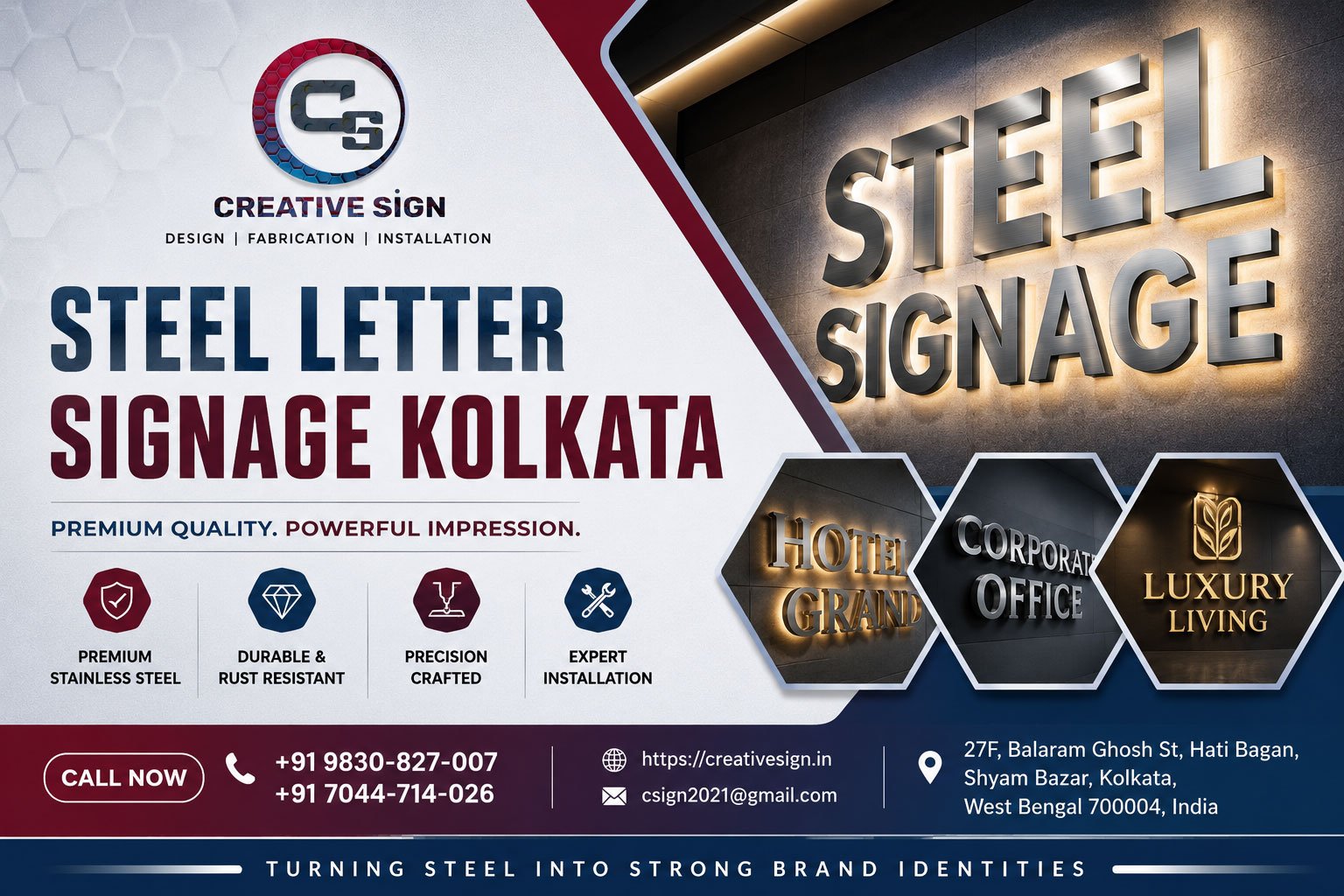
A business sign is often the first physical impression customers get before they enter a shop, office, showroom, restaurant, clinic, or commercial building. In a busy city such as Kolkata, where storefronts compete for attention across markets, high streets, shopping areas, and commercial neighborhoods, the right signage needs to be more than attractive—it needs to remain readable, professional, and durable.
Steel letter signage Kolkata is increasingly preferred by businesses that want a clean architectural appearance without relying on temporary-looking materials. Stainless steel letters can create a premium façade, while 3D fabrication techniques can give branding greater depth and visibility.
However, choosing the right metal, finish, letter thickness, mounting method, illumination, and installation approach requires practical consideration. This guide explains what business owners should know before ordering custom metal lettering for a Kolkata property.
Steel lettering has become popular because it combines visual simplicity with structural durability. Unlike printed banners or some inexpensive board materials, fabricated metal letters can form part of a building’s permanent visual identity.
A well-designed installation can work particularly well for:
The biggest advantage is versatility. A brushed stainless-steel finish can provide a subtle contemporary appearance, while mirror-polished steel can create a more reflective premium effect. Painted or powder-coated finishes can also be considered when a brand requires a particular colour.
In Kolkata’s urban environment, signage is frequently exposed to dust, humidity, rain, pollution, and direct sunlight. Material selection therefore matters as much as visual design.
The word “steel” can describe several different fabrication approaches. For exterior business lettering, stainless steel is commonly considered because of its corrosion resistance and relatively low maintenance requirements.
The appropriate grade and thickness depend on the application. Indoor reception lettering does not necessarily need the same construction as large outdoor letters mounted several metres above ground level.
An experienced fabricator should consider:
This assessment helps prevent a common problem: selecting a material purely because it looks good in a sample photograph.
The appearance of stainless steel lettering can vary substantially depending on its surface treatment.
Brushed stainless steel has a fine linear texture and generally produces a sophisticated, understated appearance. It is suitable for offices, corporate buildings, clinics, premium retail interiors, and contemporary storefronts.
Mirror-finished stainless steel has a highly reflective surface. It can create a striking visual effect, particularly when combined with architectural lighting, although fingerprints, dust, and surface marks can be more noticeable.
Gold-toned or coloured finishes can be produced through appropriate finishing processes when a business wants a warmer or more distinctive appearance.
Another important consideration is letter construction. Flat-cut letters are relatively simple, while fabricated or built-up letters provide greater depth. The right option depends on the brand identity, façade, budget, and desired viewing distance.
Custom fabrication is useful because businesses rarely have identical requirements.
The lettering can be customised according to:
For example, a small boutique may benefit from compact brushed-metal letters mounted directly against a textured wall. A larger showroom may require deeper 3D letters with concealed fixing systems so that the branding remains visible from a greater distance.
The objective should not simply be to make the letters larger. Good signage balances scale, readability, architectural proportion, and brand recognition.
Three-dimensional lettering is particularly useful when a business wants its name to have visual depth rather than appear like a flat graphic applied to a wall.
Built-up letters can create shadows and highlights as natural light changes throughout the day. This gives the façade more dimensional character.
They are especially useful for:
The depth should be selected according to the letter size and installation distance. Excessive depth on a small sign can look disproportionate, while very shallow construction may not produce the intended 3D effect on a large façade.
Illumination can also be incorporated. Depending on the design, lighting may be front-lit, back-lit, or combined with other lighting techniques. Concealed LED systems can create a halo effect behind the letters, giving the sign visibility after sunset without making the entire façade excessively bright.
A practical point from fabrication work is that illumination should be planned during the design stage—not added as an afterthought. Space for LEDs, wiring, transformers, access, drainage, and maintenance should be considered before manufacturing begins.
Indoor signage allows greater flexibility because the material is protected from direct weather exposure. Reception walls, lift lobbies, conference rooms, and showroom interiors can use finer finishes and more delicate construction.
Outdoor signage requires a more rigorous approach. The installation must account for rain, moisture, dust, wind exposure, sunlight, and the condition of the mounting surface.
For an outdoor project, ask the fabricator about:
These details are often more important than choosing between two visually similar finishes.
Outdoor installations face challenges that indoor signage does not. Kolkata’s monsoon conditions make water management and corrosion resistance particularly important.
A professional installation should consider how water behaves around the letters and fixing points. Poorly planned mounting can allow water to remain trapped behind components, potentially affecting the substrate or hardware over time.
The wall itself also matters. A strong brick or concrete surface can support a different fixing strategy from a lightweight cladding system. The installer should inspect the façade rather than assume every wall can accept the same anchors.
For larger letters, structural stability becomes increasingly important. Wind loading, letter weight, mounting depth, and fixing points should all be considered.
A useful rule is simple: the bigger and higher the letters, the less acceptable it is to treat installation as a cosmetic job.
The purpose of signage is communication. Even premium-looking letters fail if customers cannot read them.
Before finalising a design, evaluate:
For example, thin lettering may look elegant when viewed from two metres away but become difficult to read from across a busy road. Similarly, a reflective finish may look impressive close up but lose contrast against a bright façade.
The best design is therefore not necessarily the most elaborate one. It is the one that communicates the business name clearly within its real environment.
When comparing suppliers, business owners often focus primarily on price. A better approach is to compare the complete specification.
Start by requesting a clear design proposal. It should show the approximate letter dimensions, finish, depth, mounting method, and illumination concept where applicable.
Then ask practical questions:
It is also sensible to review examples of completed installations rather than relying exclusively on digital mock-ups. Fabricated metal lettering can look different in actual daylight depending on the surface, viewing angle, and surrounding architecture.
For a Kolkata project, local site knowledge can be valuable because installation conditions vary considerably between old buildings, modern commercial complexes, roadside shops, and interior commercial premises.
The cheapest quotation may use a different thickness, finish, fixing method, or fabrication process. Compare specifications rather than comparing only the final number.
A beautiful letter design cannot compensate for weak or unsuitable mounting conditions. The substrate should be assessed before fabrication.
Business owners sometimes prioritise minimalism and underestimate viewing distance. If the storefront faces a busy road, readability should be tested from the actual customer approach.
More lighting does not automatically mean better visibility. Excessive brightness can reduce visual sophistication and create glare.
Every exterior sign eventually collects dust and environmental residue. Choose finishes and mounting systems that can be cleaned and serviced without unnecessary difficulty.
Measurements taken from assumptions or old drawings can lead to alignment problems. A physical site measurement is preferable before final production.
An effective signage project begins with the environment rather than the material.
First, observe the building during both daytime and evening conditions. Identify where customers are approaching from and determine how much time they have to see the sign.
Second, keep branding consistent. The letter style, proportions, spacing, and finish should complement the company’s existing visual identity.
Third, think about future maintenance. If lighting components or concealed hardware may need servicing, access should be incorporated into the installation plan.
Fourth, request a final proof before fabrication. Once stainless steel letters are cut and finished, changing dimensions or typography can become expensive.
Finally, don’t overlook installation quality. Accurate alignment, consistent spacing, secure fixing, clean cable management, and careful finishing can make the difference between a professional façade and an average one.
For businesses considering fabricated lettering in Kolkata, Creative Sign focuses on practical signage requirements alongside appearance. The objective is to create signage that suits the building, communicates the brand clearly, and remains appropriate for its intended environment.
Creative Sign is based at 27F, Balaram Ghosh St, Hati Bagan, Shyam Bazar, Kolkata, West Bengal 700004, India. Businesses can discuss their requirements through +91 9830-827-007 or +91 7044-714-026, or email csign2021@gmail.com.
Before moving ahead with production, it is useful to share the logo, preferred dimensions, installation location, photographs of the façade, and any existing brand guidelines. These details allow the design and fabrication requirements to be evaluated more realistically.
The right Steel letter signage Kolkata solution is not simply about selecting shiny metal letters. It involves understanding the building, viewing distance, material specification, finish, fabrication method, mounting system, lighting, weather exposure, and long-term maintenance.
For shops and businesses, stainless steel can provide a durable and professional visual identity when correctly specified and installed. Custom fabrication also makes it possible to match the lettering to different architectural styles, brand identities, and practical site requirements.
If you are researching the Best Steel Letter Signage in Kolkata for Businesses and Shops, focus on workmanship and specification rather than price alone. Ask for realistic measurements, material details, installation planning, and examples of completed work. A well-designed sign should look appropriate on day one and continue representing the business effectively for years.
Yes, stainless steel can be a strong option for exterior signage when the appropriate material, finish, hardware, and installation method are selected. Outdoor performance depends not only on the face material but also on fixing components, fabrication quality, water exposure, and maintenance. A site inspection is advisable for large or elevated installations.
Neither is universally better. Flat-cut letters can provide a clean, understated appearance and may suit smaller applications. 3D letters create depth, shadows, and stronger visual presence, making them useful for larger façades and prominent entrances. The choice should depend on viewing distance, building scale, brand style, and budget.
Yes. Stainless steel letters can be combined with different illumination approaches, including front lighting and concealed backlighting. The lighting system should be incorporated into the design before fabrication so that LED placement, wiring, power supplies, access, and maintenance can be properly planned.
Maintenance generally involves periodic cleaning to remove dust and environmental deposits. The exact cleaning method depends on the surface finish. Brushed surfaces should be cleaned in a way that respects the grain direction, while harsh abrasive products should generally be avoided unless specifically recommended for the material. Periodic inspection of mounting hardware and illuminated components is also sensible.
Provide the business name and logo, approximate letter size, photographs of the installation area, building or wall type if known, preferred finish, whether lighting is required, and the approximate installation height. If possible, provide the viewing distance and explain whether the sign is intended primarily for pedestrians, passing vehicles, or both. These details help produce a more realistic proposal than a quotation based only on the business name.